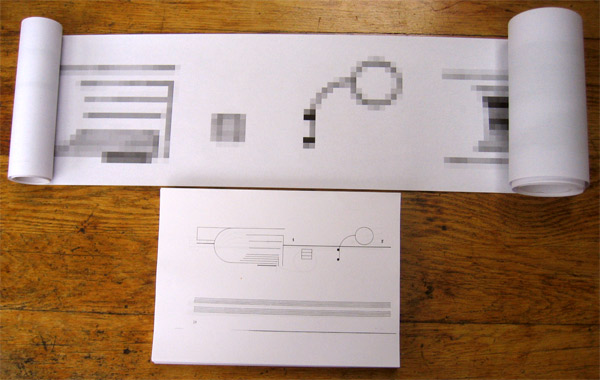
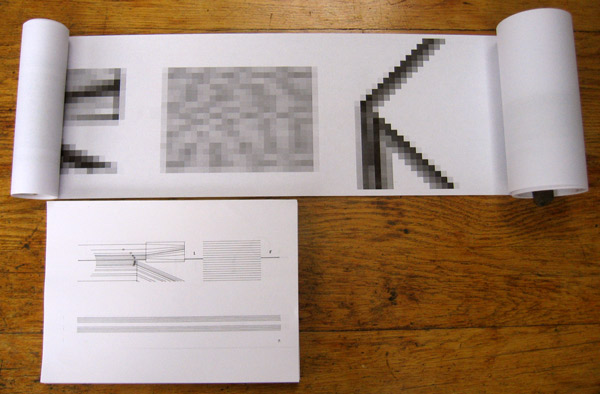
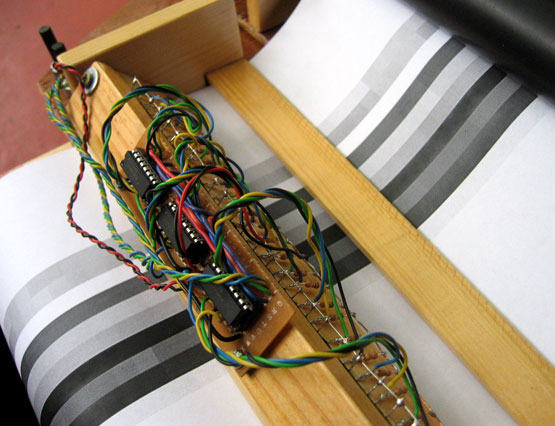
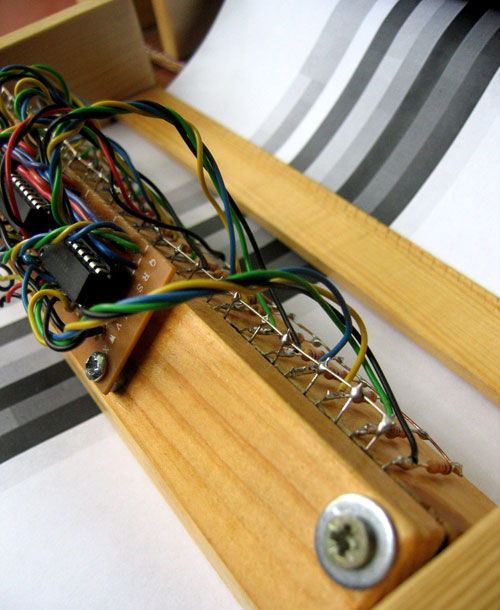
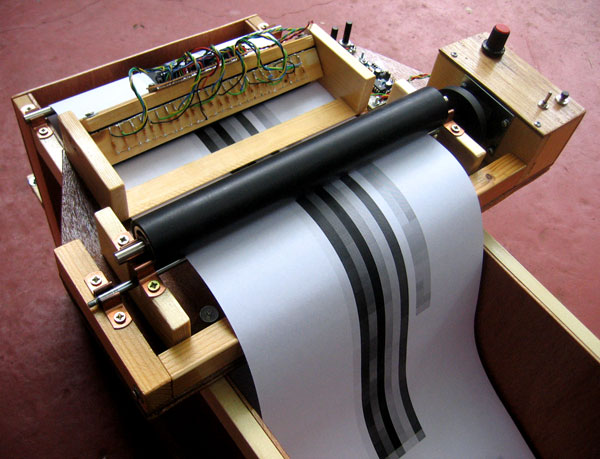
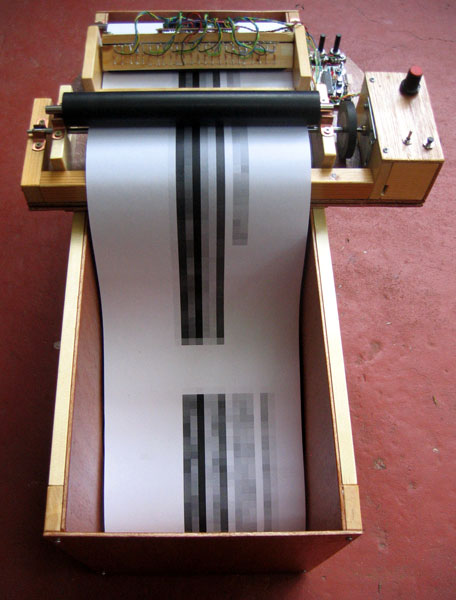
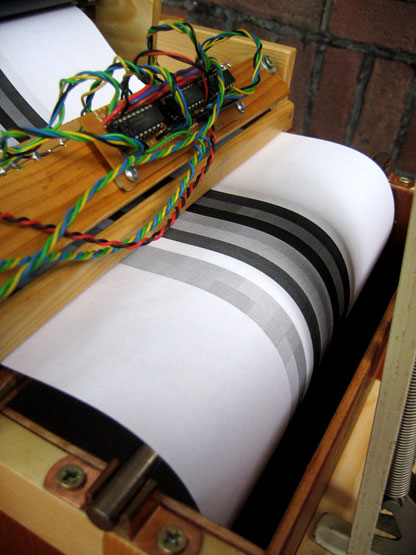
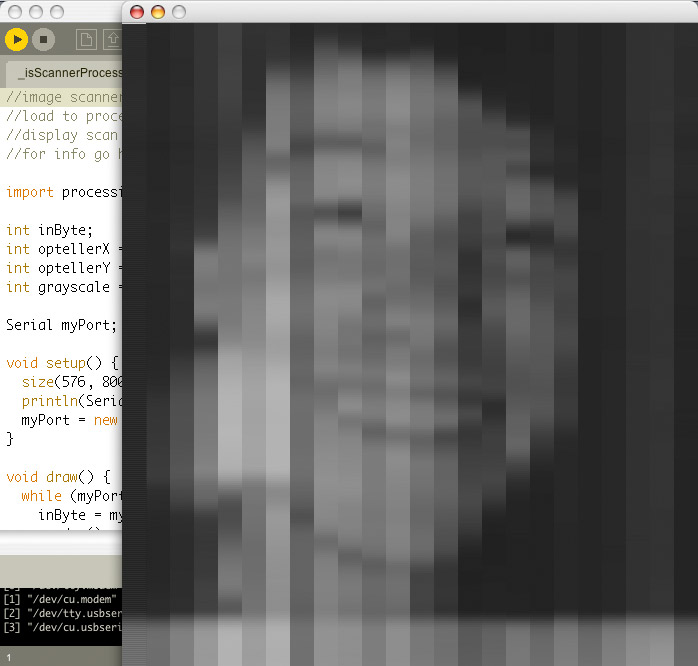
//Image Scan Sequencer, by: Gijs Gieskes 2008
//Copyleft: This is a free work, you can copy, distribute, and modify it
//under the terms of the Free Art License:
//http://artlibre.org/licence/lal/en/

//MIDI
byte setNoteOn = 0x90;
byte setNoteOff= 0x80;

byte pitch = 65;
int velocity = 0;

int arpegiator = 0;
long prevMillis = 0;
byte stateArrCounter = 0;
byte arpCounter = 0;
byte prevPitch = 0;
boolean enableNoteOff = true;
boolean rearangeYesNo = false;
boolean arpegiatorYesNo = false;

boolean read11 = HIGH;
int noteOnRange = 0;

//multiplex variables
int multiArray[3][8] = {
                     {0,0,0,0,0,0,0,0},
                     {0,0,0,0,0,0,0,0},
                     {0,0,0,0,0,0,0,0}
                     };

byte stateArray[3][24]= {
                      {0,0,0,0,0,0,0,0,0,0,0,0,0,0,0,0,0,0,0,0,0,0,0,0},
                      {0,0,0,0,0,0,0,0,0,0,0,0,0,0,0,0,0,0,0,0,0,0,0,0},
                      {0,0,0,0,0,0,0,0,0,0,0,0,0,0,0,0,0,0,0,0,0,0,0,0}
                      };

void setup() {
  DDRB = DDRB | B00000111;  // 10, 9, 8 zijn outputs

  pinMode(11, INPUT);
  digitalWrite(11, HIGH);

  //baut reet:
  Serial.begin(31250);
  //Serial.begin(9600);
}

void loop() {

    //read multiplexor inputs
    readAnalogs();

    switcher();

    //bepaalt de hoeveelheid noten die gespeelt worden in de arpegio.
    stateArrCounter = 0;

    //modify/organize recieved data
    for(byte i=0; i<3; i++){
      for(byte j=0; j<8; j++){
        int avals = multiArray[i][j];
        velocity = (noteOnRange - avals);                 //inverse
        velocity = map(velocity, 0, noteOnRange, 0, 127); //bazeer de velocity op de noteOnRange.
        velocity = constrain(velocity, 0, 127);           //voor de zekerheid..

        if(avals <= noteOnRange){
          stateArray[0][stateArrCounter] = setNoteOn;
          stateArray[1][stateArrCounter] = pitch;
          stateArray[2][stateArrCounter] = velocity;
          stateArrCounter++;
        }else{
          stateArray[0][stateArrCounter] = setNoteOff;
        }

        pitch++;
      }
    }
    //als er weinig noten zijn word de arpegiator speed hoger.
    if(arpegiatorYesNo == true){
      arpegiator = (stateArrCounter*16)+10;
    }
    //re-organize and send data as arpegio
    if(millis() - prevMillis > arpegiator) {
       prevMillis = millis();

       if(rearangeYesNo == true){
         rearangeToVel();  //reanrange notes to velocity
       }

       arpCounter++;
       if(arpCounter >= stateArrCounter){arpCounter = 0;}

       byte arpOnOff = stateArray[0][arpCounter];
       byte arpInPitch = stateArray[1][arpCounter];
       byte arpInVel = stateArray[2][arpCounter];

       if(arpInPitch != prevPitch){
         sendMIDI(setNoteOn, arpInPitch, arpInVel);
       }

       if(arpCounter == 0 && arpOnOff == setNoteOff && enableNoteOff == true){
         sendMIDI(setNoteOff, arpInPitch, 0);
         enableNoteOff = false;                                                  //set note off once
       }

       if(arpInPitch != prevPitch){                                              //turn off the last played note
         sendMIDI(setNoteOff, prevPitch, 0);
         enableNoteOff = true;                                                   //set note off once
       }

       prevPitch = arpInPitch;
    }

    //just some delay
    delay(8);
}

//http://itp.nyu.edu/physcomp/Labs/MIDIOutput
void sendMIDI(char sb, char data1, char data2) {
  Serial.print(sb, BYTE);
  Serial.print(data1, BYTE);
  Serial.print(data2, BYTE);
}

//lees de multiplex LDRs in
void readAnalogs(){
  for(byte i=0; i<8; i++){
    PORTB &= B11111000;
    PORTB |= i;                         //schijf naar poort 10,9,8
    delayMicroseconds(3);               //geef de multiplexor de teid om te schakelen..
    multiArray[0][i] = analogRead(0);
    multiArray[1][i] = analogRead(1);
    multiArray[2][i] = analogRead(2);
  }
}

//http://www.arduino.cc/playground/Main/DigitalSmooth
void rearangeToVel(){
  boolean done = 0;                // flag to know when were done sorting
  byte temp0 = 0;
  byte temp1 = 0;
  byte temp2 = 0;
  while(done != 1){        // simple swap sort, sorts numbers from lowest to highest
    done = 1;
    for (byte j = 0; j < (stateArrCounter - 1); j++){
      if (stateArray[2][j] > stateArray[2][j + 1]){     // numbers are out of order - swap
        temp0 = stateArray[0][j + 1];
        temp1 = stateArray[1][j + 1];
        temp2 = stateArray[2][j + 1];
        stateArray[0][j+1] =  stateArray[0][j] ;
        stateArray[1][j+1] =  stateArray[1][j] ;
        stateArray[2][j+1] =  stateArray[2][j] ;
        stateArray[0][j] = temp0;
        stateArray[1][j] = temp1;
        stateArray[2][j] = temp2;
        done = 0;
      }
    }
  }
}

void switcher(){
  read11 = digitalRead(11);
  int Aread4T = analogRead(4);
  int Aread5T = analogRead(5);
  if(read11 == LOW){
    if(Aread4T < 512){
      noteOnRange = Aread5T/2;
      pitch = 65;
    }else{
      //switch to select different types of playback (rearange to vel and vel dendant speed).
      if(Aread5T < 255){
        rearangeYesNo = true;
        arpegiatorYesNo = false;
      }else if(Aread5T < 512 && Aread5T >= 255){
        rearangeYesNo = false;
        arpegiatorYesNo = true;
      }else if(Aread5T < 765 && Aread5T >= 512){
        rearangeYesNo = false;
        arpegiatorYesNo = false;
      }else{
        rearangeYesNo = true;
        arpegiatorYesNo = true;
      }
      pitch = 65;
    }
  }else{
    pitch = (Aread5T/10)+1;
    arpegiator = ((1023 - Aread4T)/2)+1;
  }
}